VI
VI
 EN
EN










WHAT IS THE CARBON CREDIT MARKET? 6 CONTENT YOU MAY NOT KNOW
Table Of Contents
Table Of Contents
Vinacontrol ensures objectivity, accuracy and reliability in assessing greenhouse gas emissions according to international standards.
Towards the goal of net-zero emissions by 2050 as agreed at the 26th Conference of the Parties to the United Nations Framework Convention on Climate Change (COP26), a carbon market is gradually taking shape. in countries. The carbon market is a place for countries with excess or shortage of emission rights to sell or buy those emission rights.
|
Content:
|
1. What are carbon credits?
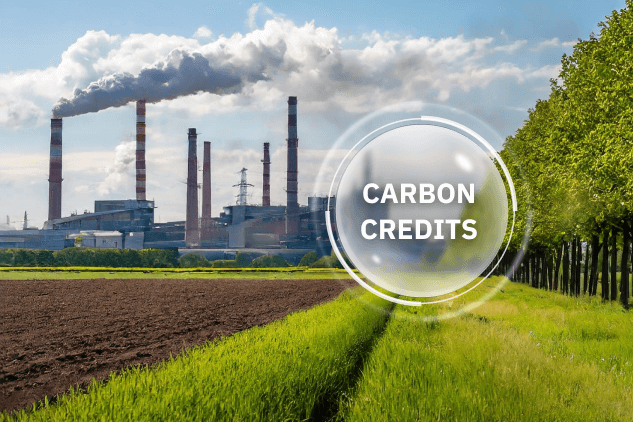
Carbon credits are the general term for tradable credits or permits representing 1 ton of carbon dioxide (CO2) or the mass of another greenhouse gas equivalent to 1 ton of CO2 (tCO2e). Trading CO2 emissions or carbon trading on the market is done through credits. The main goal of creating carbon credits is to reduce emissions of carbon dioxide and other greenhouse gases from industrial activities, in order to reduce the impact of global warming.
Carbon credits are certificates for commercial transactions and represent the right to emit greenhouse gases, specifically CO2.
2. Overview of carbon credits in Vietnam.
The Vietnamese market has nearly 40 million carbon credits, but the reality is even higher and all types such as forests, oceans, renewable energy, energy saving... can all create carbon credits. Notably, it is expected that in the future, each year Vietnam will have millions of voluntary carbon credits provided, accompanied by a large demand for exchange or trading. Therefore, the formation of a carbon market will help Vietnam seize opportunities in effectively reducing carbon emissions; At the same time, it increases compatibility with international carbon pricing institutions.
On January 7, 2022, the Government issued Decree 06/2022/ND-CP regulating greenhouse gas emissions mitigation and ozone layer protection. This Decree has specific regulations on the development roadmap and timing of implementing the domestic carbon market. In particular, the period until the end of 2027 will: Develop regulations on carbon credit management, activities of exchanging greenhouse gas emission quotas and carbon credits; develop regulations for operating the carbon credit exchange; Pilot implementation of the carbon credit exchange and offset mechanism in potential areas and guide the implementation of the domestic and international carbon credit exchange and offset mechanism in accordance with the provisions of law and regulations. international conventions to which the Socialist Republic of Vietnam is a member; Establish and organize pilot operation of a carbon credit exchange from 2025; Implement capacity building activities and raise awareness about carbon market development.
From 2028, it will: Organize the operation of an official carbon credit exchange in 2028; Regulating activities connecting and exchanging domestic carbon credits with regional and world carbon markets.
3. Overview of the carbon credit market
3.1. History of carbon market development
The carbon market has its roots in the United Nations Kyoto Protocol on climate change, adopted in 1997. Under the Kyoto Protocol, countries with excess emissions rights sell to or buy from other countries. country emits more or less than its committed target. Since then, a new type of commodity has appeared in the world, namely certificates for reducing/absorbing greenhouse gas emissions. Because carbon (CO2) is the equivalent greenhouse gas of all greenhouse gases, transactions are collectively called carbon trading and exchange, forming the carbon market or carbon credit market.
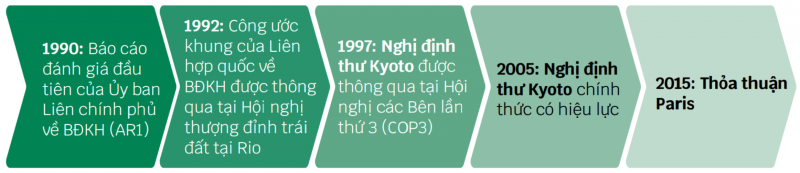
Along with the transition of the international carbon market from the mechanisms under the Kyoto Protocol to the mechanisms under the Paris Agreement, domestic and linked carbon markets are also gradually being formed based on policies and goals. climate standards of one or more countries or territories.
These carbon markets are often mandatory carbon markets, created on the basis of an emissions trading system (ETS), with or without carbon credits and offset mechanisms. More and more ETS are being developed following the introduction of EU-ETS. Currently, there are a total of 34 ETS in operation in the world with the controlled greenhouse gas emission rate reaching 17%, 3 times higher since the EU-ETS went into operation in 2005.
3.2. Two types of carbon markets:
The carbon market is divided into two, including mandatory and voluntary markets.
a. Mandatory carbon market: The market is established through the constraints of countries that have signed and ratified the Kyoto Protocol, so projects under KP mechanisms are considered a mandatory carbon market.
b. Voluntary carbon market/Voluntary carbon market: based on bilateral or multilateral cooperation agreements between organizations, companies or countries. Credit purchasers engage in transactions on a voluntary basis to meet environmental, social and corporate governance (ESG) policies to reduce their carbon footprint.

3.3. How does the carbon credit market work?
The trade in carbon credits is regulated by governments or international organizations responsible for setting limits on the amount of greenhouse gases (in units of CO2) that can be emitted. Businesses are therefore allocated a specific amount of carbon they can emit annually. If they exceed this limit, they need to purchase carbon credits or carbon offsets. If they don't exceed the limit, they can sell unused carbon credits or businesses that need them.
According to the World Economic Forum, the number of licenses on the market is limited as the total amount is an attempt to match the reduction target. At the start of the trading period, emissions permits can be purchased at auction or given to businesses for free. Over time, the number of available licenses has decreased, contributing to pressure on participating businesses to reduce emissions and invest in cleaner production solutions. The goal is that over the long term the price of new and cleaner technologies will decrease while innovation increases.
3.4. Benefits of the carbon credit market
Promote sustainable development
Carbon markets create new sources of income for emissions reduction projects and activities, such as afforestation, forest protection and renewable energy development. Encourage international cooperation in addressing climate change Queen. Countries can trade carbon credits with each other, giving developing countries more resources to fulfill their climate commitments.
Reduce greenhouse gas emissions
Carbon markets create economic incentives for businesses to reduce greenhouse gas emissions. Businesses can buy carbon credits from other sources if they exceed their assigned emission quotas. This encourages them to invest in cleaner and more efficient technologies to reduce emissions. Carbon markets also help transition to a carbon-neutral economy. As carbon prices increase, businesses will tend to switch to renewable energy sources and lower-emission production methods.
Enhance economic efficiency
- Effective policy tools to reduce greenhouse gas emissions at the lowest cost.
- Increase transparency and efficiency in greenhouse gas emissions management.
- Image enhancement: Possessing forest carbon credits demonstrates an organization's commitment to environmental protection and sustainable development.
- Like other investment markets, forest carbon credits will be standards-based and help all participants learn, compare and consider investments.
4. Regulations on carbon credits in Vietnam
Forest carbon credits in Vietnam are being regulated and receive important support from legal documents, notably:
Environmental Protection Law 2020:
With the introduction of the 2020 Environmental Protection Law, Vietnam has set strict regulations on the protection and development of natural resources, especially forests, with the goal of absorbing and storing carbon. This law not only clearly defines the responsibility for forest conservation but also emphasizes the important role of forests in mitigating and responding to climate change. The provisions of the law have created a strong legal foundation to promote forest carbon credit activities.
Decree 57/2018/ND-CP dated April 17, 2018:
This Decree sets out an important incentive mechanism for the development of forest carbon accounting projects and the provision of forest environmental services. Accordingly, organizations, businesses, households and grassroots communities with forest land that are conserving and developing forests are encouraged to actively participate in implementing these projects and receive forest carbon credits later. When conducting. This Decree not only creates favorable conditions but is also an important driving force, promoting forest protection and carbon management in Vietnam.
Decree 06/2022/ND-CP:
This Decree regulates greenhouse gas emission mitigation, ozone layer protection, carbon market organization and development and measures to promote activities on greenhouse gas emission mitigation and protection. ozone layer. The Decree applies to organizations and individuals involved in greenhouse gas emission activities, emission mitigation and greenhouse gas absorption; Participate in developing the domestic carbon market, connecting with regional and world carbon markets; Production, import, export, consumption and disposal of substances that deplete the ozone layer and substances that cause the greenhouse effect are controlled under the Montreal Protocol on Substances that Deplete the Ozone Layer .
5. How do organizations/businesses earn carbon credits?
To achieve carbon credits, organizations/businesses need to do the following:
- Participate in afforestation or forest management projects: This is one of the effective ways to gain carbon credits. Protecting forests not only preserves resources but also helps absorb carbon from the environment.
- Buy, sell and exchange carbon credits on the exchange: The carbon credit exchange is a place where individuals and organizations can buy, sell and exchange carbon credits according to specific regulations and standards.
- Engage in circular manufacturing processes: Optimizing resource use, recycling and saving energy can generate carbon credits.
- Greenhouse gas inventory: Survey, determine emissions activities and measure the amount of greenhouse gases an organization creates during operations and production.
- Analysis and assessment: Consider various aspects of production and operations to assess greenhouse gas emissions.
- Reduce greenhouse gases: Establish measures to effectively reduce greenhouse gases.
- Use renewable energy, environmentally friendly energy: Investing in renewable energy not only reduces energy costs but also helps create carbon credits.
6. How can Vinacontrol help businesses?
As the leading reputable conformity assessment organization in Vietnam, Vinacontrol ensures objectivity, accuracy, timeliness and reliability in assessing greenhouse gas emissions in compliance with regulations of regulatory agencies. State regulations and international standards. Vinacontrol provides a consulting service package for Greenhouse Gas Inventory - Guidance on quantifying and reporting greenhouse gas emissions according to ISO 14064-1 including the following activities:
- Business survey - Determine inventory goals and scope
- Identify emission activities; Collect information, documents, and records to serve quantitative inventory activities.
- Emission quantification.
- Greenhouse gas inventory by base year.
- Greenhouse gas inventory report.
- Instructions for collecting information and proactively preparing greenhouse gas inventory reports.
Creating a public, accurate, and objective report on greenhouse gas inventory with a reputable and independent organization like Vinacontrol is a proactive demonstration of compliance with regulations of the Government of Vietnam and other countries. in the world, while demonstrating the business's strong commitment to sustainable development.