VI
VI
 EN
EN








WHAT IS NET ZERO? AND HOW TO ACHIEVE IT
Table Of Contents
Table Of Contents
VINACONTROL guarantees objective, accurate, and reliable assessment of greenhouse gas emissions according to international standards.
The negative impacts of climate change are having a serious impact on the global scale, requiring the international community to act more strongly, responsibly and without delay on a global scale. Governments around the world agreed to strive for Net Zero by 2050 as part of the Paris Agreement, signed in 2014. However, making declarations is always easier than implementing and achieving them. practical results. Besides, there will be confusion due to the many terms involved.
1. What is Net Zero?
Net Zero is achieved when the total amount of greenhouse gases (such as CO2, CH4, N2O) emitted by humans is rebalanced by removing these gases from the atmosphere through carbon removal. This requires not only reducing emissions from sources such as transport, industrial production and electricity generation, but also includes enhancing carbon sequestration through measures such as planting new forests. , forest conservation, carbon capture and storage technology. Achieving Net Zero is like achieving “climate neutrality”.
2. Net Zero and Carbon Neutral: What's the difference?
Carbon Neutral means that in order to achieve zero carbon emissions for a company, location, product, brand or event, it must first be measured through a greenhouse gas inventory, then reduce emissions to the extent possible and then offset the remaining emissions with an equivalent amount of avoidable emissions. The goal of carbon neutrality is to minimize the impact of human activities on climate change and promote sustainable development. This can be achieved by purchasing enough Carbon credits to make up the difference.
In contrast, Net Zero is a much more ambitious target, requiring organizations or businesses to reduce Carbon emissions throughout the supply chain from the first suppliers in the value chain to the end user. , a remarkable effort in a world where companies do not control their entire value chain.
Net Zero aims to achieve the goal of not creating any additional CO2 emissions into the atmosphere, i.e. creating a net zero emissions Carbon Neutral still emits CO2 but ensures all of it is completely eliminated by the amount of CO2 produced, to achieve carbon neutrality.
Net Zero focuses on reducing carbon emissions throughout the supply chain from production to consumption. Carbon Neutral is only concerned with reducing carbon at the production stage of the product, often through the use of clean, emission-free energy sources. CO2 emissions.
3. How to achieve Net Zero?
A number of scientific studies clearly show that to prevent the worst effects of climate change, while preserving a livable planet, global temperature rise needs to be limited to 1 .5°C above pre-industrial levels. The Paris Agreement seeks to keep global temperature rise below 2°C and pursue efforts to keep it to 1.5°C. Currently, the Earth is about 1.1°C warmer than late 1800s and emissions continued to increase. New research from the World Resources Institute (WRI, 2021) shows that to achieve the Paris agreement target, emissions need to be reduced by 45% by 2030 and reach net zero by 2050.
The article titled “The meaning of Net Zero and how to do it right” published in the Oxford University scientific journal Nature Climate Change in December 2021, pointed out 7 attributes to successfully achieve Net zero:
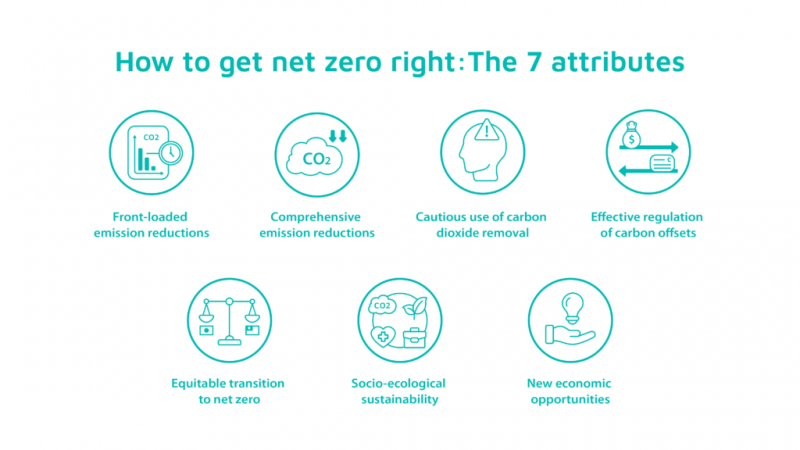
a. Reduce emissions from the start
The IPCC has identified more than 200 pathways to reduce carbon emissions to reach Net Zero. The short-, medium- and long-term goals for carbon reduction along these pathways vary, but companies should make the effort and choose to reduce carbon significantly in the short term rather than ramp up efforts once they have already enter the middle and later stages, because it is still unclear whether global temperature changes are reversible and the greenhouse gases accumulated in the previous stages will cause a consistent increase in temperature. Research has demonstrated that a delay of years before starting emissions reductions reduces the time remaining to achieve net-zero emissions while remaining below 1.5°C by about two years.
Additionally, the IPCC has calculated carbon reduction pathways based on current environmental conditions. Therefore, if future climate change gives rise to wildfires, ocean acidification (which impacts marine ecosystems), and other factors that cause carbon sinks to die and reduce carbon stocks, then the lack of appropriate carbon reduction measures will occur. in the early stages leads to a loss of flexibility in responding to problems.
b. Comprehensive emissions reduction
In contrast to Net Zero, the core difference of carbon neutrality is the comprehensive assessment of greenhouse gas emissions. Therefore, actions to realize this goal are not limited to increasing the use of clean energy but also include air conditioning, engines, waste disposal methods and all related behaviors. can create greenhouse gas emissions. This requires a concerted effort by all sectors, including those that struggle to reduce carbon, e.g. heavy industry, architecture, agriculture, aviation and mining. Low-carbon industries are also initially required to take actions other than reducing their own carbon footprint. For example, banks may offer premium green loans or green investment programs.
c. Use caution when using carbon dioxide remover
Although humans are currently investing and conducting research into direct atmospheric carbon capture and storage (DACCS) technology—capturing atmospheric CO2 and storing it underground—we cannot predict predict its long-term impact on the environment after sending large amounts of CO2 into the environment. amount of CO2 entering the stratum. Furthermore, afforestation is easily affected by accidents such as floods and fires, leading to lower than expected results. Therefore, reducing carbon emissions at the source is a top priority. CO2 removal methods should only be implemented (and cautiously) once we have entered the stage where carbon reduction is no longer possible.
d. Effective regulation of carbon offsets
Currently, carbon credits are provided by many independent organizations with different programs and calculation methods, so there is a lack of a standard monitoring mechanism. As a result, many plans are not properly designed and the external impacts stemming from implementing the plans are not comprehensively considered while the number of carbon credits also exceeds estimates. Right now, corporations can learn more about what each carbon offset program does in practical terms to ensure that the money spent on purchasing carbon credits is actually invested in climate action with enough power. In addition, proactively inventorying greenhouse gases also helps businesses calculate effective carbon credit investment options.
e. Fair transition to Net Zero
Many of today's wealthy countries have undergone high-polluting, low-cost development. However, if they treat countries with developing economies equally in the Net Zero process, they can cause inequality between countries as well as poverty while protecting the environment. Therefore, there is a need for separate Net Zero roadmaps designed according to country contexts. Investments in these resource-poor countries, clean energy use and low-polluting development are also sources of some carbon credits. Therefore, corporations can purchase suitable carbon credits or establish low-carbon business models in developing countries.
f. Socio-ecological sustainability
Today, climate change is the most pressing issue to be addressed, but other environmental and social aspects also need to be considered while minimizing global warming. For example, farmers should not be deprived of agricultural land for the purpose of planting exotic crops; This behavior can affect people's livelihoods and even destroy the ecosystem. A better way would be to bring together local people, authorities and interest groups to investigate the details and provide those affected with adequate compensation or suitable employment opportunities. other case.
g. New economic opportunities
Many believe that Net Zero will harm the national economy and corporate profits because achieving it is an arduous process, including industrial facility procurement and conversion.
However, from a national perspective, reducing compensation for highly polluting industries (e.g. petrochemical fuels) could help develop other new and alternative industries (e.g. solar energy, wind energy and energy storage) and create a new economic model that is less polluting and with high added value.
On the other hand, if corporations can take the lead in greenhouse gas inventories to reduce carbon, they will have more advantages in competing with rivals as well as attracting more consumers, capital and more talented.
4. How can Vinacontrol help businesses?
As the leading reputable conformity assessment organization in Vietnam, Vinacontrol ensures objectivity, accuracy, timeliness and reliability in assessing greenhouse gas emissions in compliance with regulations of regulatory agencies. State regulations and international standards. Vinacontrol provides a consulting service package for Greenhouse Gas Inventory - Guidance on quantifying and reporting greenhouse gas emissions according to ISO 14064-1 including the following activities:
- Business survey - Determine inventory goals and scope
- Identify emission activities; Collect information, documents, and records to serve quantitative inventory activities.
- Emission quantification.
- Greenhouse gas inventory by base year.
- Greenhouse gas inventory report.
- Instructions for collecting information and proactively preparing greenhouse gas inventory reports.
Creating a public, accurate, and objective report on greenhouse gas inventory with a reputable and independent organization like Vinacontrol is a proactive demonstration of compliance with regulations of the Government of Vietnam and other countries. in the world, while demonstrating the business's strong commitment to sustainable development.