VI
VI
 EN
EN












Draft Survey
Table Of Contents
Table Of Contents
 Service Background
In maritime bulk cargo transportation, the accurate determination of cargo weight loaded or discharged is a critical factor for payment, contract settlement, and dispute resolution.
Draft Survey is a technical method used to determine the weight of cargo by calculating the vessel's displacement change before and after loading or discharging. This is a highly specialized marine survey technique, primarily applied to:
- Dry Bulk Cargo: Coal, ore, clinker, cement, grain, etc.
- High-volume shipments where direct weighing is impractical.
- Import-export transactions under FOB/CFR/CIF terms.
- Payments based on actual weight received/delivered.
Vinacontrol’s Draft Survey services empower businesses to:
✔ Accurately determine the quantity of cargo delivered or received.
✔ Establish a reliable basis for payment and contract settlement.
✔ Mitigate dispute risks between Shippers, Shipowners, and Buyers.
✔ Enhance transparency in international trade transactions.
When should a Draft Survey be performed?
Businesses should engage Draft Survey services in the following cases:
- During the export or import of bulk cargo via sea vessels.
- When payment is based on actual delivered weight.
- When direct weighing of the entire cargo is not feasible.
- When required by commercial contracts or Letters of Credit (L/C).
- When there are suspicions of quantity discrepancies.
- When an independent inspection certificate is required for insurance or legal claims.
Survey Locations:
- Loading Ports / Discharge Ports
- Anchorages
- Barges, coastal vessels, and inland waterway craft.
Scope of Services
Vinacontrol’s Draft Survey process includes:
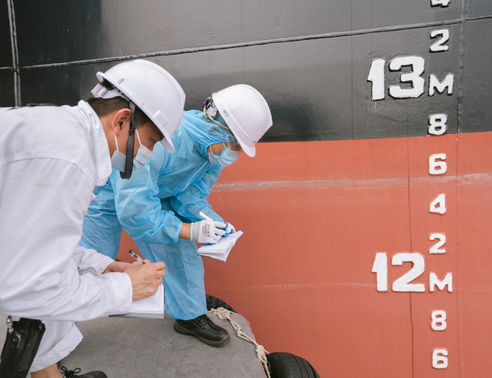
1. Six-Point Draft Reading
- Forward (Port & Starboard)
- Midships (Port & Starboard)
- Aft (Port & Starboard)
- Calculating the mean draft at each position and the vessel's overall mean draft based on technical principles (Mean of Means).
2. Measurement & Correction of Influencing Factors
- Measuring water density using a hydrometer.
- Checking and calculating ballast water volume.
- Determining fuel (FO, DO) and lubricating oil quantities.
- Measuring fresh water and domestic water reserves.
- Accounting for vessel stores and constant weights.
3. Hydrostatic Table Reference
- Determining total displacement.
- Correcting for actual water density.
- Calculating Trim and List corrections (if applicable).
4. Cargo Weight Calculation Cargo Weight = (Post-loading/discharge Displacement – Pre-loading/discharge Displacement) ± Necessary Corrections.
5. Issuance of Inspection Certificate
- Detailed reporting of all measurements.
- Clear explanation of calculation methodologies.
- Final conclusion on cargo weight.
- Issuance of certificates for payment and legal purposes.
Applicable Standards
Draft surveys are performed in accordance with:
- ISO/IEC 17020:2012 (Requirements for the operation of inspection bodies).
- International Maritime Inspection Practices.
- Commercial Contract Regulations and Incoterms.
- Technical guidelines from the International Federation of Inspection Agencies (IFIA) or equivalent maritime associations.